From cloud engineer to forward deployed engineer (FDE) on AWS
· 11 min read
Indeed logged 643 forward-deployed engineer postings in April 2025. A year later it counted 5,330, a 729% jump, according to Indeed data shared with Business Insider.
On 30 June 2026, AWS announced a dedicated Forward Deployed Engineering organisation backed by $1 billion. Its consulting partners hire for the same title, and so do AI vendors whose customers run on AWS.
A forward deployed engineer (FDE) builds AI systems inside a customer’s environment and stays until they run in production. If you already work with AWS, you already have part of the skill set.
This post covers five things: what the role is, how it differs from roles you know, the AWS skills that job posts ask for, how FDEs work with AI coding agents, and one project you can build to prove you can do the work.
What a forward deployed engineer does
Developers build the platform and the product. Forward deployed engineers sit with one customer and make the product solve that customer’s problem.
AWS defines the role as someone embedded directly inside a strategic enterprise customer to design, build, deploy, and run AI-powered production systems alongside the customer’s engineering team. FDEs write production-grade software and own outcomes end-to-end, from prototype through enterprise-scale deployment.
“Alongside” means the customer’s engineers build with you. The engineering bar is the same at every employer. Kevin Shatzkamer, who leads forward deployed engineering at Microsoft, wrote in October 2026 that “‘Engineer’ remains non-negotiable.” The work, he added, still requires “production code, systems architecture, integrations, evaluations, observability.”
How the role differs from SA, ProServe and SDE work
| Forward deployed engineer | Solutions architect | Professional services consultant | |
|---|---|---|---|
| Main output | Production code in the customer’s account and repos | Reference designs, workshops, proofs of concept | Scoped project delivery against a statement of work |
| Time with one customer | Weeks inside the team (about 45 days in reported AWS engagements) | Many accounts at once, over months or years | Project length, often months |
| Measured on | A system in production that the customer can run alone | Adoption and consumption across a territory | Delivery against scope and budget |
| Writes production code? | Yes, daily | Rarely | Yes, often |
I have worked as a solutions architect at AWS, so I know where that job stops. An SA engagement usually ends with a custom-designed architecture, a workshop, or sometimes a proof of concept. The customer’s team then carries the design to production.
SDEs have the engineering depth but often lack customer-facing experience. An SDE builds one product for many users. FDE work narrows that to one system for one customer, with that customer in the room.
Profiles tend to make the move well: SAs who still write code, and platform engineers who have run production systems. SDEs who like customer contact have a good path too.
Where AWS-focused FDE jobs sit
You do not need to join a cloud provider to do this work on AWS.
AWS partners: consulting partners now advertise FDE roles inside their AWS practices. Deloitte lists a “Forward Deployed Engineer - AWS” role in more than 40 US locations and describes “pod-based delivery”. Caylent’s post asks FDEs to build “in the client’s codebase, not a sandbox.” RevStar wants “3+ years in a client-facing consulting, Solutions Architecture, or Forward Deployed Engineering role.”
AI vendors and ISVs: model providers and software vendors hire FDEs to get their product working at a customer site. Many of those customers run on AWS, so the deployment lands in the customer’s AWS account. The vendor’s FDE needs the same AWS skills as a partner’s FDE; only the product on top differs.
Partner roles bring variety across customers and industries, while a vendor role means depth in one product. Both build on the same AWS skills.
The AWS skill stack
An AWS-focused FDE needs skills in four layers:
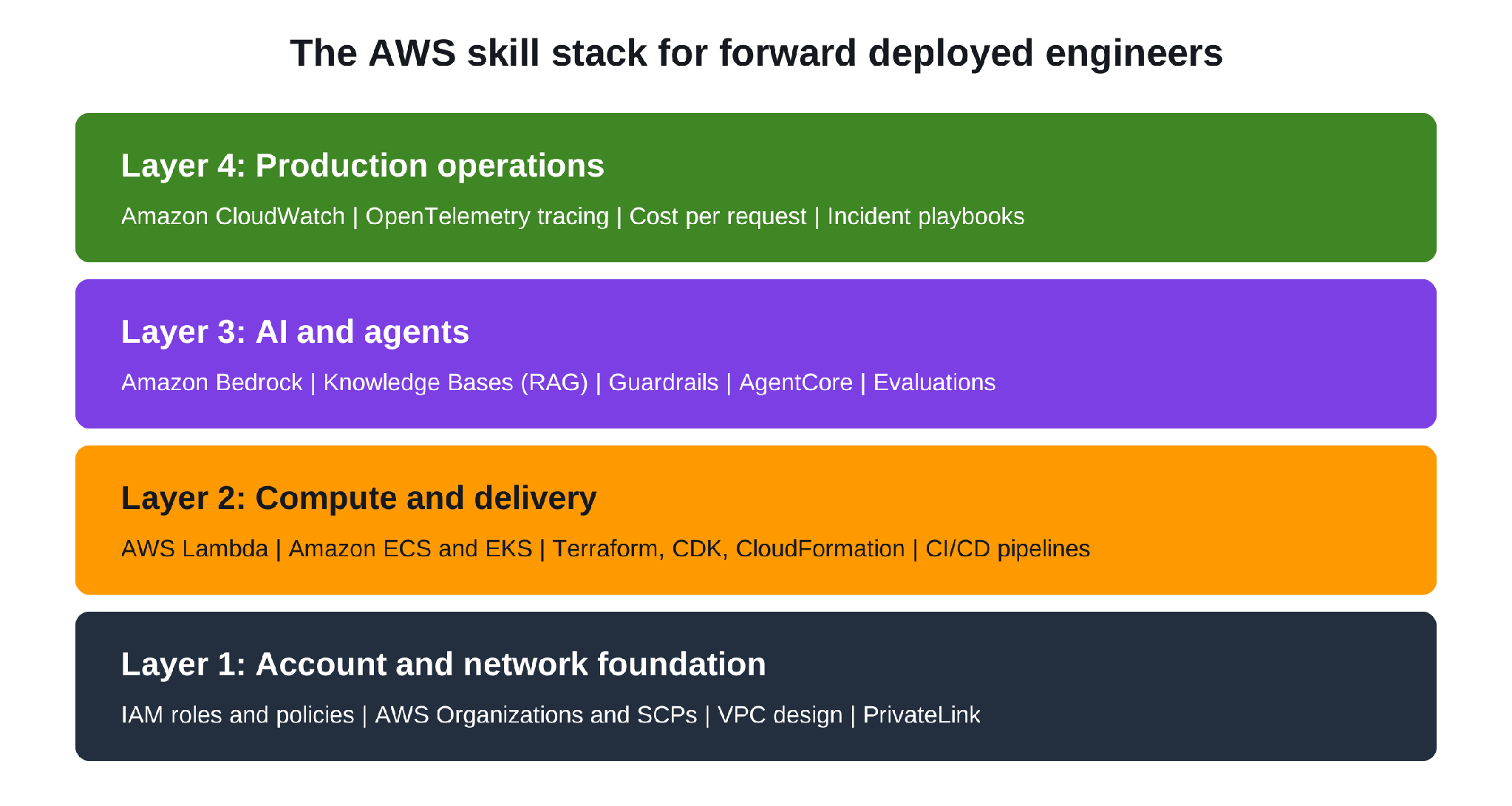
Figure 1: The four layers of the AWS skill stack for forward deployed engineers.
Account and network foundation: you will work inside the customer’s AWS landing zone, so you need to be able to navigate it, especially in large and custom multi-account AWS setups; this can get complex. You need to understand and work within service control policies (SCPs) set in AWS Organizations, IAM policies, and preconfigured VPC design. Regulated customers often require private connectivity, so learn how to reach Amazon Bedrock through AWS PrivateLink endpoints.
Compute and delivery: agents and their tools need somewhere to run. Know AWS Lambda for event-driven use cases and Amazon ECS or Amazon EKS for long-running services. Proficiency in Terraform, AWS CDK, or CloudFormation is important, along with CI/CD pipelines such as GitHub Actions, GitLab CI, or AWS CodePipeline.
AI and agents: this is the layer most cloud engineers need to learn. Start with Amazon Bedrock as the basis: model access, Knowledge Bases for retrieval-augmented generation (RAG), Guardrails for content filtering, and model evaluation. Then look into Amazon Bedrock AgentCore, which gives agents a managed runtime, memory, identity, and a gateway to tools. Testing the agent takes as much work as building it, so eval frameworks, agent tooling, RAG pipelines, and prompt engineering are core skills.
Production operations: an agent in production needs observability, such as Amazon CloudWatch for metrics and dashboards. Add OpenTelemetry tracing to follow one request through its model calls and tool calls. Track cost per request, because token spend is harder to predict than compute spend. Write incident playbooks before launch. For more details, see Operations for AI on AWS: How to run AI agents in production.
Work with AI coding agents
FDEs are expected to operate “agentic-first”, compressing deployments and projects that would take months to days. An FDE now writes much of the code through an AI coding agent, and spends the saved time on specs and reviews.
Claude Code: Anthropic’s coding agent runs in the terminal and in the IDE. It can call Claude models through Amazon Bedrock with AWS credentials, so inference runs in the customer’s AWS account under their IAM policies. Project rules live in a CLAUDE.md file in the repo.
Codex: OpenAI’s coding agent has been generally available on Amazon Bedrock since June 2026.
Kiro: the agentic IDE from AWS is built around specs. It turns a prompt into requirements and a design document, then into a sequenced task list. Steering files hold the project rules. Hooks are “event-driven automations that execute when you save or create files.”
Principles
Write the spec first: in spec-driven development, you write the requirements and the design as documents before the agent writes code. The agent works from those documents. The customer’s engineers can then review what you intend to build first.
Keep context in the repo: put build commands and naming rules in the context file, whether that is CLAUDE.md, AGENTS.md or a Kiro steering file. Add short architecture notes and the actions the agent must never take.
Limit what the agent can touch: give the agent scoped IAM credentials. Keep it out of production accounts and let the pipeline deploy.
Keep a human in the loop for high-risk changes: you answer for the code, whoever produced it.
Skills outside the stack
The stack and the coding agents cover the technical side. Four other skills decide how an engagement goes.
Discovery and scoping: customers often arrive with vague requirements such as “we want AI in our support process.” Your first job is to turn that into a measurable outcome and drive alignment through regular demos and updates.
Writing: you will write design docs and decision records, plus status notes each week.
Working in someone else’s organisation: you don’t control the customer’s security review, change windows, and data access approvals.
Handover: the system outlives the engagement, so plan for that from day one. You are responsible for runbooks and architectural documentation, and for training internal champions.
Build one project that proves it
A support-ticket triage agent works well as the example, since most companies have tickets. The agent reads an incoming ticket and looks up the product docs. It then assigns a category and a priority, and drafts a reply.
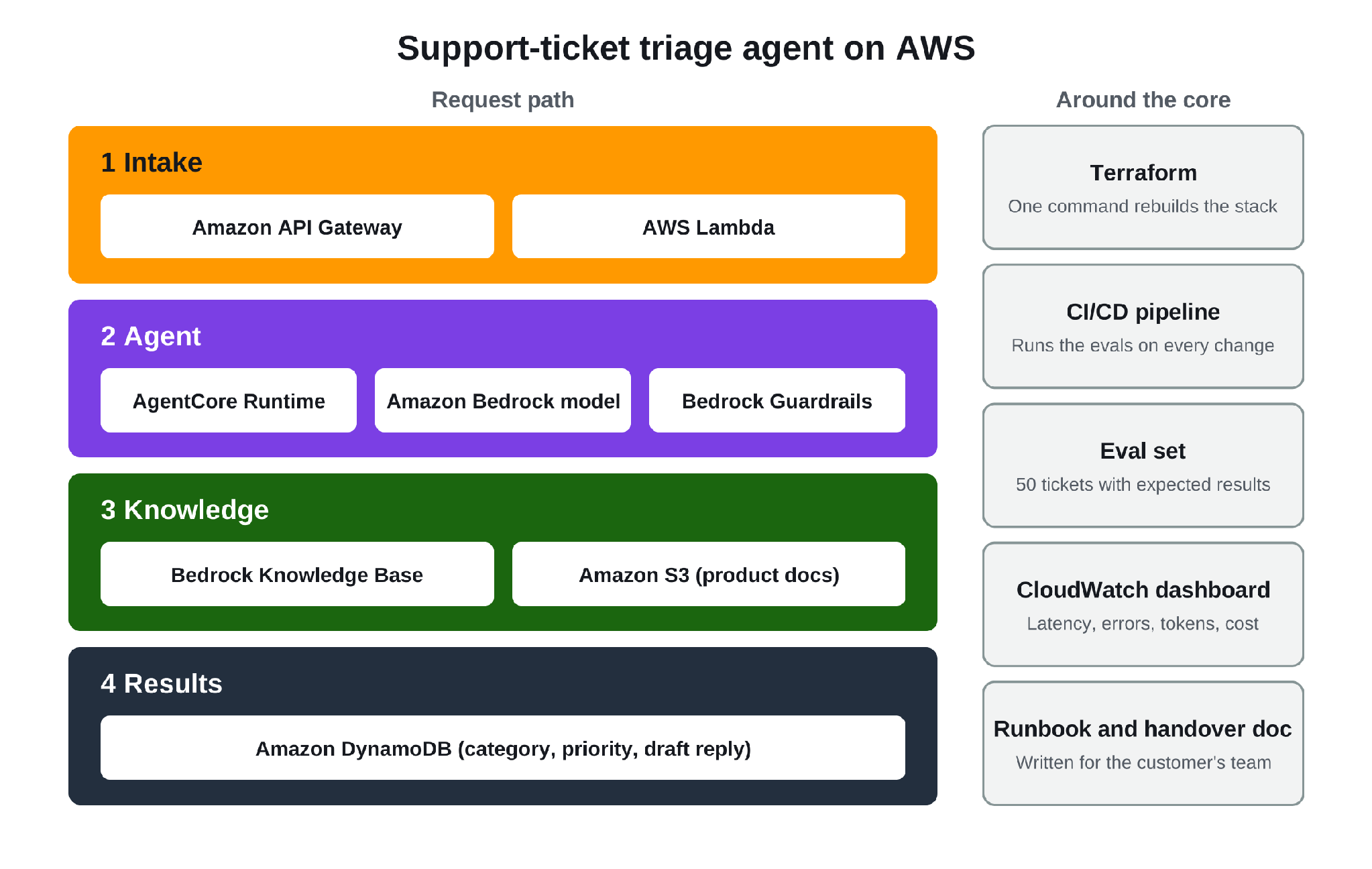
Figure 2: Architecture of the support-ticket triage agent on AWS.
Intake: Amazon API Gateway receives the ticket, and an AWS Lambda function passes it to the agent.
Agent: the agent runs on AgentCore Runtime and calls a model on Amazon Bedrock, with Guardrails applied to input and output.
Knowledge: a Bedrock Knowledge Base indexes the product docs stored in Amazon S3.
Results: the category and priority land in an Amazon DynamoDB table, next to the draft reply.
Build it with a coding agent, and commit the specs and the context file next to the code. An interviewer can then see how you work with the agent.
Around that core, add the parts that make this production-ready. Define everything in Terraform, so one command rebuilds the stack. Write an eval set of 50 real-looking tickets with the expected category and priority for each; run it in the pipeline on every change. Build a CloudWatch dashboard with latency, error rate, token use and cost per ticket. Write a runbook for the failures you can predict: the model throttles, the Knowledge Base returns nothing, a guardrail blocks a valid ticket, or cost spikes overnight.
In an interview, show four things: the repo, eval results before and after a change, cost per ticket, and the handover doc. The before-and-after results carry the most weight, because they show that you measure your work.
Certifications: what still counts
The AWS Certified Generative AI Developer - Professional (AIP-C01) is the main AWS credential for AI work. AWS says it validates the ability to build production-ready AI solutions using “foundation models, RAG architectures, and vector databases.” My AIP-C01 cheat sheet covers the exam.
Partner posts ask for the older professional certifications: Solutions Architect - Professional or DevOps Engineer - Professional. I have written about both: a Solutions Architect - Professional cheat sheet and a DevOps Engineer - Professional guide.
Key takeaways
The role: an FDE is a production engineer with a customer attached. You ship code under the customer’s rules and leave a system their team can run.
The stack: on AWS, job posts ask for four layers: account and network foundation, compute and delivery, AI and agents, production operations.
The proof: one project with an eval set, a dashboard, a runbook and a handover doc beats a dozen tutorials.
The method: FDEs build with AI coding agents such as Claude Code, Codex and Kiro. Write the spec first, and review every change the agent makes.
Frequently asked questions
What is a forward deployed engineer?
A forward deployed engineer (FDE) builds AI systems inside a customer’s environment and stays until they run in production. AWS defines the role as someone embedded inside a strategic enterprise customer to design, build, deploy and run AI-powered production systems alongside the customer’s engineering team.
How is an FDE different from a solutions architect?
A solutions architect covers many accounts at once and usually delivers reference designs, workshops or proofs of concept; the customer’s team then carries the design to production. An FDE spends weeks inside one customer’s team, writes production code daily, and is measured on a system in production that the customer can run alone.
Do you need to work for AWS to be an FDE on AWS?
No. AWS consulting partners such as Deloitte, Caylent and RevStar advertise FDE roles inside their AWS practices. AI vendors and ISVs also hire FDEs, and because many of their customers run on AWS, the deployment lands in the customer’s AWS account.
What AWS skills does an FDE need?
Four layers: account and network foundation (IAM, AWS Organizations and SCPs, VPC design, PrivateLink), compute and delivery (Lambda, ECS or EKS, Terraform, CDK or CloudFormation, CI/CD), AI and agents (Amazon Bedrock, Knowledge Bases, Guardrails, AgentCore, evaluations), and production operations (CloudWatch, OpenTelemetry tracing, cost per request, incident playbooks).
Which AI coding agents do FDEs use on AWS?
Claude Code can call Claude models through Amazon Bedrock with AWS credentials, so inference runs in the customer’s account. Codex has been generally available on Amazon Bedrock since June 2026. Kiro, the agentic IDE from AWS, turns a prompt into requirements, a design document and a task list.
What project proves you can do FDE work?
A support-ticket triage agent: API Gateway and Lambda for intake, an agent on AgentCore Runtime calling a Bedrock model with Guardrails, a Bedrock Knowledge Base over product docs, and results in DynamoDB. Add Terraform, an eval set of 50 tickets run on every change, a CloudWatch dashboard, a runbook and a handover doc.
Which certifications help for FDE roles on AWS?
The AWS Certified Generative AI Developer - Professional (AIP-C01) is the main AWS credential for AI work. Partner job posts ask for Solutions Architect - Professional or DevOps Engineer - Professional.